Word Cards
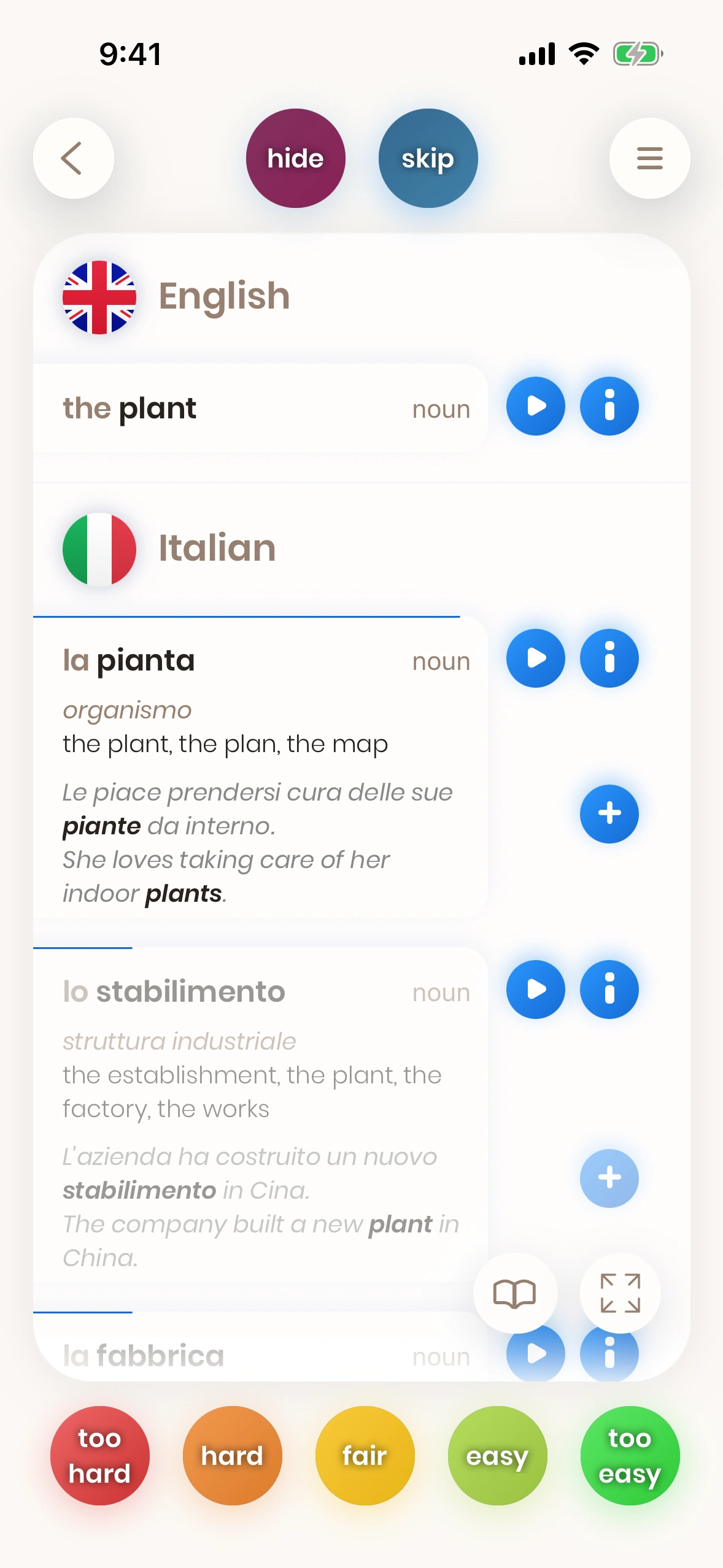
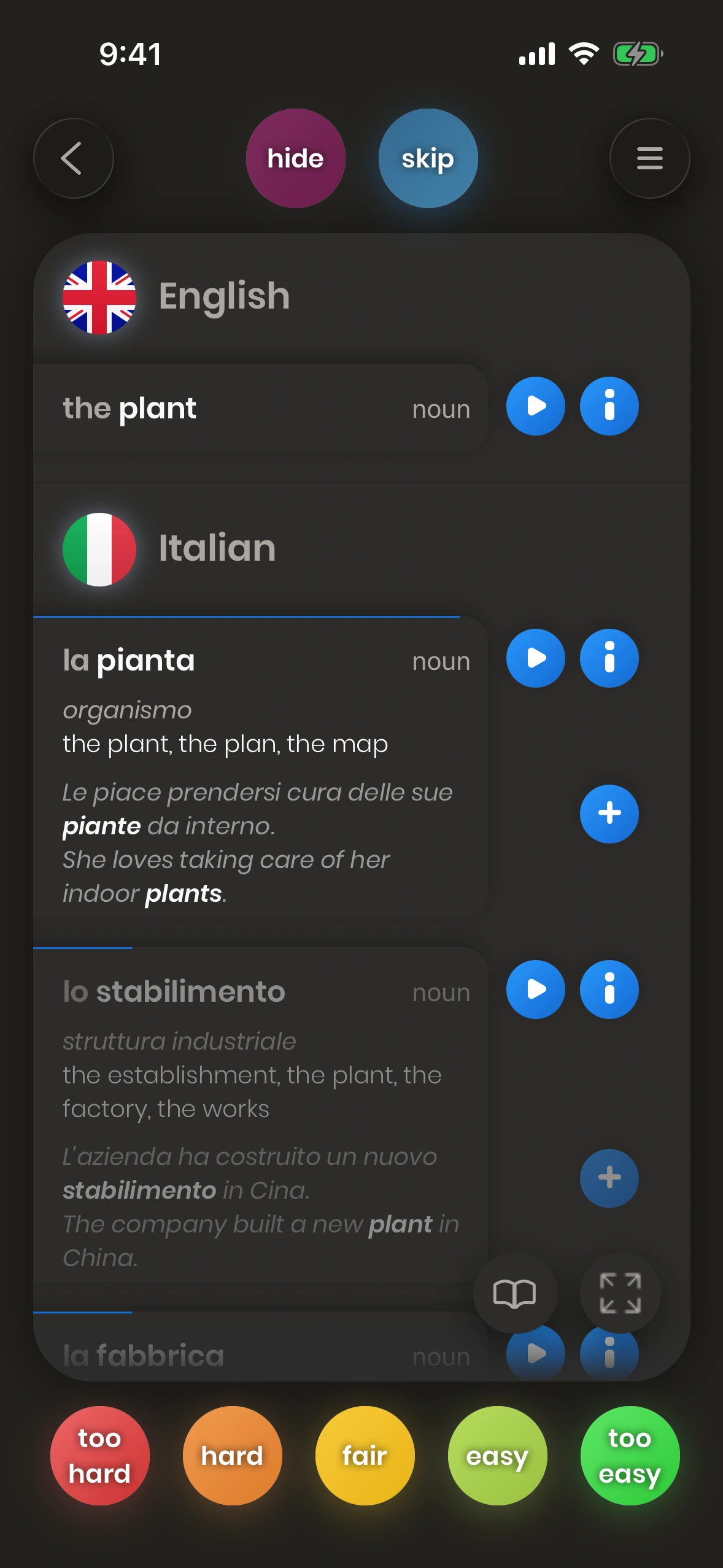
A word card shows you, well, a word. There are word cards in two directions:
English-to-English words
An English-to-English card shows you an English word, and lets you translate it.
These cards train your passive vocabulary. You learn to understand English words, but you might not yet use them actively.
Many cards show you more than one translation, because for many words, there is more than one.
However, you do not need to know all the translations. If you are able to think of one of the first translations, then you can treat this card as "learned". We get into more details about this later.
English-to-English words
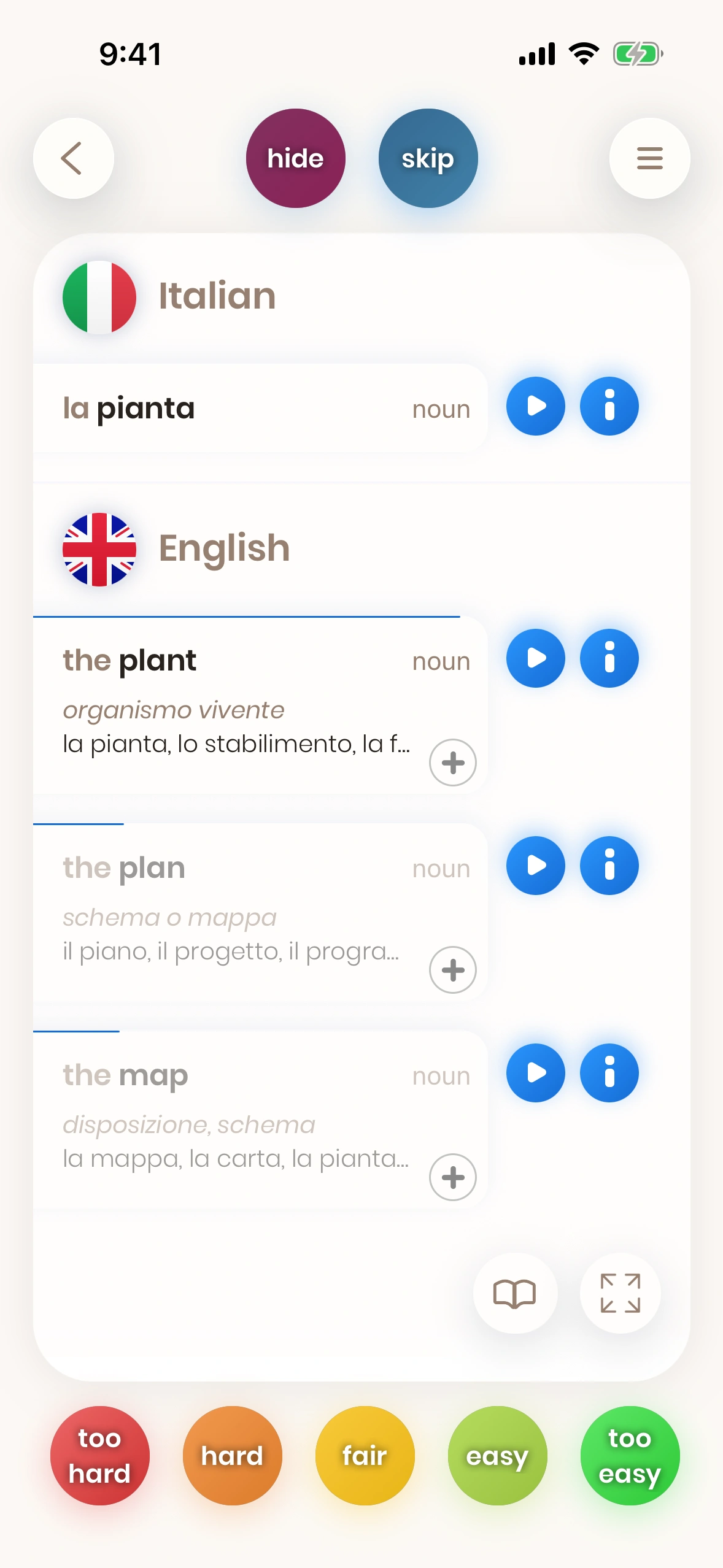
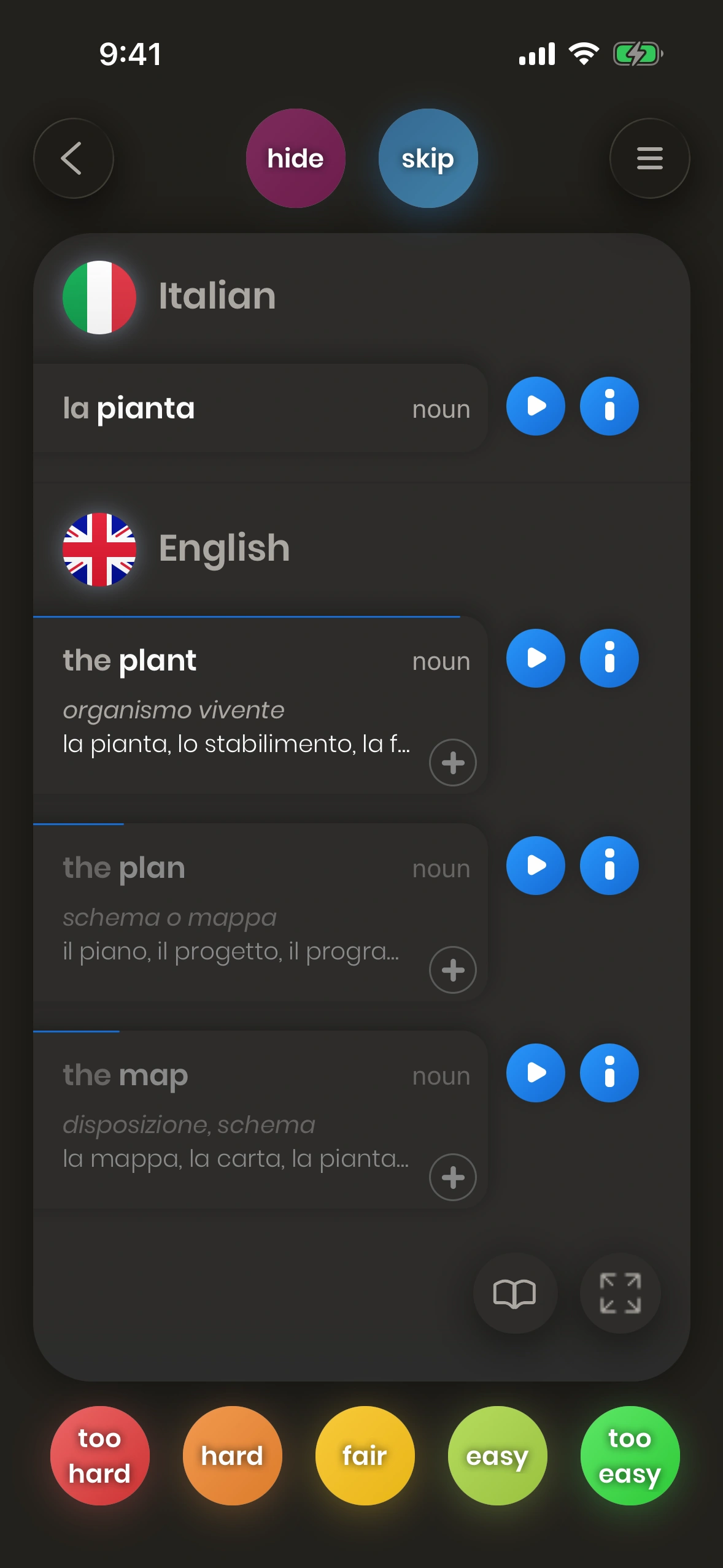
An English-to-English card shows you an English word, and lets you translate it into English.
These cards train your active vocabulary. You start to actively search for English words, and use them.
Does every word card exist in both direction?
When a user learns the English-to-English card "the plant" - "la pianta", they frequently ask whether this card also exists as "la pianta" - "the plant".
The answer is mostly yes. Most word cards have their direct counterpart, which show the same words, but in the reverse direction. There are however a few caveats:
- Most words have more than one valid translation. For example, "la pianta" can be translated to "the plant", but also to "the plan".
- The same is true for the other direction. "the plant" can be translated to "la pianta", but "la fabbrica" might be a valid translation too.
Just English offers cards for all words:
- la pianta ==> the plant, the plan
- the plant ==> la pianta, la fabbrica
- the plan ==> la pianta
- etc.
As you can see, the cards exist "in both directions", but most of the time, there is more than one card in the other direction.
If you progress through a word course, you will get cards in both directions. This allows you to train both your active and passive vocabularies.